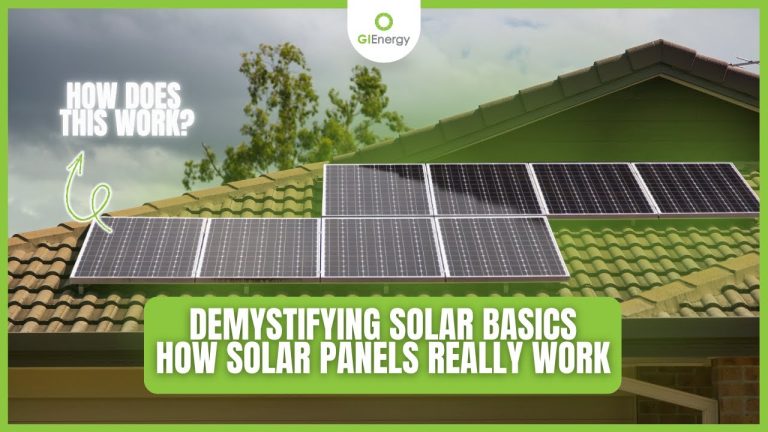
The sun is a massive power source, and for a long time, using it to run our homes felt like something out of a sci-fi movie.
But now, it’s totally possible.
With energy prices going up and everyone looking for greener options, solar panels are popping up everywhere.
Still, many people aren’t quite sure how they actually work.
If you’ve ever wondered about the magic behind solar panels, you’re in the right spot.
This guide will break down how they work and the whole system in a way that’s easy to get.
Key Takeaways
- Solar panels work by using the photovoltaic effect, where sunlight hitting silicon cells creates an electric charge.
- This charge, in the form of direct current (DC), needs to be converted into alternating current (AC) by an inverter to power your home’s appliances.
- A complete solar system includes panels, an inverter, mounting hardware, and sometimes battery storage for excess energy.
- Solar energy can power your home, reduce water heating costs, and increase your energy independence from the grid.
- Factors like sun exposure, temperature, panel type, and shading affect how well your solar panels perform.
Understanding The Photovoltaic Effect
The Core Principle Of Solar Power
So, how exactly do those shiny panels on your roof turn sunshine into electricity? It all comes down to something called the photovoltaic effect.
Think of it as the magic trick that makes solar power possible.
The word itself gives us a clue: ‘photo’ means light, and ‘voltaic’ relates to electricity.
So, it’s literally about light creating voltage, or electricity.
How Silicon Creates An Electric Field
Solar panels are made up of many smaller units called solar cells.
Most of these cells are built using silicon, a material that’s pretty good at conducting electricity, but not perfectly.
It’s a semiconductor.
To make these cells work, the silicon is treated in a special way, creating two distinct layers.
The Role Of N-Type And P-Type Layers
These two layers are key.
One layer is treated to have extra electrons, making it ‘N-type’ (negative).
The other layer is treated to have ‘holes’ where electrons are missing, making it ‘P-type’ (positive).
When you put these two layers together, a natural electric field forms right at the boundary between them.
This field is like a tiny, built-in push that will become super important in a moment.
Here’s a simple breakdown of the layers:
- N-Type Layer: Has an excess of electrons.
- P-Type Layer: Has a deficit of electrons (or an abundance of ‘holes’).
When these layers meet, the extra electrons from the N-type layer move to fill the holes in the P-type layer near the junction.
This movement creates an electric field that pushes any newly freed electrons in a specific direction.
This carefully engineered electric field within the silicon is what directs the flow of electricity once sunlight hits the panel.
Without it, the energy from the sun would just dissipate without creating a usable current.
The Journey Of Sunlight To Electricity
So, how does all that sunshine actually turn into power for your toaster? It’s a pretty neat process, and it all starts with the sun’s rays hitting your solar panels.
Think of it like a tiny, high-tech dance happening on your roof.
Sunlight Strikes the Solar Cell
When sunlight beams down, it’s made up of tiny packets of energy called photons.
These photons are the initial spark.
They travel from the sun and hit the surface of your solar panels, specifically the photovoltaic cells within them.
These cells are usually made of silicon, a material that’s really good at interacting with light.
Freeing Electrons With Light Energy
Once those photons land on the silicon, they transfer their energy.
It’s like a tiny nudge.
This energy is enough to knock loose some of the electrons that are normally bound to atoms within the silicon.
When enough photons hit, they free up a whole bunch of these electrons. These freed electrons are the key to generating electricity.
The Electric Field Directs Electron Flow
Now, just having loose electrons isn’t enough.
They need to go somewhere and do something.
This is where the special layers inside the solar cell come into play.
Remember how the N-type and P-type layers create an electric field? This field acts like a gentle push, guiding all those newly freed electrons in a specific direction.
They’re nudged away from the P-type side and towards the N-type side.
This organized movement of electrons is what we call an electric current.
Collecting the Generated Current
Finally, to actually use this flow of electrons, we need to collect it.
Thin metal strips, like tiny wires, are built into the solar cell.
These strips act as collectors, gathering up the moving electrons.
From these collectors, the electricity flows out of the solar panel as Direct Current (DC).
It’s not quite ready for your home appliances yet, but it’s the first step in a bigger journey.
This whole process, from light hitting the panel to electrons moving, happens constantly as long as the sun is shining.
It’s a quiet, efficient conversion happening right above your head.
Transforming Power For Your Home
So, your solar panels are out there, soaking up the sun and doing their thing, creating electricity.
But hold on, that electricity isn’t quite ready for your toaster or your TV just yet.
Solar panels actually produce something called Direct Current, or DC power.
Think of it like a one-way street for electricity.
Most of the stuff in your house, though, runs on Alternating Current, or AC power, which is like a two-way street, constantly switching direction.
This is where a really important piece of equipment comes in.
Why Direct Current Needs Conversion
DC power, the kind your solar panels make, is great for some things, like charging your phone or powering certain electronics.
But it’s not what your home’s wiring is set up for.
Trying to run your refrigerator or your lights directly on DC power would be like trying to fill a bucket with a hose that’s only spraying water in one direction – it just doesn’t work with the system you have.
Your home’s appliances and electrical outlets are designed for the back-and-forth flow of AC power.
The Essential Role Of The Inverter
This is where the inverter steps in.
It’s basically the translator between your solar panels and your home’s electrical system.
The inverter’s main job is to take that DC electricity from the panels and flip it into the AC electricity that your appliances can actually use. Without an inverter, all that sunshine captured by your panels wouldn’t be very useful for powering your everyday life.
It’s a pretty clever bit of tech that makes solar power practical for your house.
From DC To Usable AC Power
Think of the inverter as the bridge connecting two different worlds of electricity.
It takes the steady, one-directional flow of DC power from your solar panels and transforms it into the oscillating, two-directional flow of AC power.
This conversion process is key.
The inverter handles this transformation efficiently, making sure the power is compatible with your home’s electrical panel and all the devices plugged into it.
It’s this conversion that allows you to power everything from your lights and computers to your washing machine and microwave using the clean energy generated by the sun.
It’s a critical step that turns raw solar energy into the electricity you use every single day.
Key Components Of A Solar System
So, you’ve got the idea of solar panels, but what actually makes up the whole setup? It’s not just the panels themselves, though they’re definitely the stars of the show.
Think of it like building a computer – you need more than just the processor.
A complete solar system is a team of parts working together to get that sunshine turned into power for your house.
The Solar Panels: Capturing Sunlight
These are the big, flat things you see on roofs.
Each panel is actually made up of many smaller solar cells, usually crafted from silicon.
When sunlight hits these cells, it triggers a process that creates direct current (DC) electricity.
The more sunlight they soak up, the more power they generate. They’re the primary collectors, the ones doing the heavy lifting of converting light into electrical energy.
The Inverter: The Power Converter
Now, the electricity coming straight from the panels is DC.
That’s great for some things, but your home appliances, lights, and pretty much everything else run on alternating current (AC).
This is where the inverter steps in.
It’s like a translator, taking the DC power and changing it into the AC power your home can actually use.
You can’t really skip this part if you want to power your toaster or TV.
Mounting Systems: Securing Your Panels
You can’t just lay solar panels on the ground and expect them to stay put, especially not on a roof! That’s where mounting systems, often called racking, come in.
These are the sturdy frameworks that securely attach your panels to your roof or to the ground if you have a ground-mounted system.
They need to be strong enough to hold the panels through wind, rain, and maybe even a bit of snow, and they’re usually angled to catch the sun best.
Optional Battery Storage Explained
This is becoming more popular.
Think of a battery as a place to store extra electricity your panels make during the day.
If you’re not using all the power right away, or if the sun goes down, you can use the power stored in the battery instead of pulling from the grid.
It’s a way to get more out of your solar setup and have backup power if the grid goes out.
It’s not strictly necessary for a system to work, but it sure adds a lot of flexibility and independence.
How Solar Powers Your Daily Life
So, you’ve got solar panels on your roof, and they’re churning out electricity.
That’s great, but what does that actually mean for your day-to-day life? It’s more than just a lower electricity bill, though that’s a big perk.
Solar energy can touch almost every part of your home and routine.
Powering Household Appliances
This is the most obvious one, right? The electricity your solar panels generate is direct current (DC).
But most of your home appliances, like your fridge, TV, lights, and washing machine, run on alternating current (AC).
That’s where the inverter comes in.
It takes the DC power from your panels and converts it into the AC power your home needs.
Essentially, your solar system becomes your home’s new power source, just like the utility grid, but cleaner and often cheaper. You can even get smart monitoring systems that show you how much energy you’re producing and using, helping you schedule high-demand tasks like running the dishwasher for when the sun is shining brightest.
This helps you get the most out of your solar energy system.
Reducing Your Water Heating Costs
Did you know that heating water can be one of the biggest energy hogs in your home? Solar water heaters are a fantastic way to cut down on those costs.
These systems use the sun’s rays to heat water, which then goes to your taps and shower.
Some systems can slash your hot water expenses by up to 80% compared to traditional electric or gas heaters.
They work by circulating water or a heat-transfer fluid through solar collectors on your roof.
Even on cloudy days, they can still capture enough energy to make a difference, and insulated tanks keep the water warm for hours.
Maximizing Energy Independence
One of the coolest aspects of solar is how it lets you take control of your energy.
With a solar system, especially if you add battery storage, you become less reliant on the utility company.
This means you’re less affected by rising electricity prices.
Plus, during power outages, your solar panels and batteries can keep your lights on and your fridge running.
It’s a great feeling knowing you have a reliable backup, especially with unpredictable weather events becoming more common.
It’s about having power when you need it, no matter what’s happening with the grid.
Solar power isn’t just about generating electricity; it’s about applying renewable energy to solve everyday problems.
From powering your home and heating your water to charging your electric car and providing backup power during outages, solar technology offers practical solutions for modern living.
As the technology improves and costs decrease, more homeowners can benefit from these applications, leading to significant energy savings and greater independence.
Factors Affecting Solar Panel Performance
The Impact Of Sun Exposure
Solar panels need sunshine to do their thing, right? It sounds obvious, but how much sun they actually get makes a big difference.
We’re talking about insolation, which is just a fancy word for the amount of solar radiation hitting your panels.
If your roof is shaded by tall trees or a neighboring building for a good chunk of the day, your panels won’t be able to soak up as much energy.
Even a little bit of shade can really cut down on how much electricity your system produces.
Think of it like trying to tan with an umbrella – you’re not going to get very dark.
So, making sure your panels are in a spot that gets direct sunlight for most of the day is super important for getting the most power out of them.
How Temperature Influences Efficiency
You might think solar panels work best when it’s super hot and sunny, but that’s not entirely true.
While they need sun, extreme heat can actually make them work a bit less efficiently.
Most solar panels are happiest when the temperature is somewhere between 59 and 95 degrees Fahrenheit.
When it gets much hotter than that, their performance can dip a little.
It’s kind of like how your phone can get sluggish if it overheats.
On the flip side, cold weather doesn’t really hurt their performance; in fact, sometimes snow can even help by reflecting more light onto the panels.
So, while you want sun, you don’t necessarily want a scorching heatwave all the time.
Understanding Panel Type Differences
Not all solar panels are created equal.
The two main types you’ll see for homes are monocrystalline and polycrystalline.
Monocrystalline panels are usually a solid black color and tend to be a bit more efficient, especially in warmer weather or partial shade.
They can be a good choice if you have limited roof space.
Polycrystalline panels, on the other hand, often have a blueish hue and are typically less expensive.
They might be a great option if you have plenty of room on your roof and aren’t dealing with extreme heat or heavy shade.
The type of panel you choose can impact both how much electricity you generate and the overall cost of your system.
The Effect Of Shading And Angle
We’ve touched on shade, but it’s worth repeating because it’s a big deal.
Even a small shadow creeping across a panel can significantly reduce its output.
This is why it’s so important to consider the placement of your panels carefully, looking out for trees, chimneys, or anything else that might cast a shadow.
The angle of your panels also plays a role.
Ideally, they should be tilted to face the sun directly.
In many places, this means facing south, but the exact best angle depends on your location and latitude.
Installers often use special tools to figure out the optimal tilt and orientation to catch the most rays throughout the year.
When planning your solar setup, think about how the sun moves across the sky during different seasons.
A system designed to capture peak sunlight in summer might not perform as well in winter if the angle isn’t adjusted or accounted for.
It’s all about maximizing that sun-catching potential year-round.
Making The Switch To Solar Energy
Benefits Beyond Electricity Generation
So, you’ve learned how solar panels work and how they can power your home.
Now, let’s talk about why making the switch is a really smart move, going beyond just seeing a lower number on your electricity bill.
It’s about more than just saving money, though that’s a big part of it.
Think about it: you’re tapping into a power source that’s literally free and abundant, every single day.
This shift means you’re taking a significant step towards energy independence. No more being completely at the mercy of utility companies and their ever-changing rates.
Plus, you’re actively contributing to a cleaner planet.
By using solar, you reduce your reliance on fossil fuels, which means fewer greenhouse gas emissions.
It’s a win-win for your wallet and the environment.
Understanding Your System’s Lifespan
When you invest in solar panels, you’re looking at a long-term solution.
Most solar panels are built to last for a good while, typically with warranties that cover performance for 25 years or more.
That’s a quarter of a century of generating your own power! Of course, like any technology, there are other components to consider.
The inverter, for instance, might have a shorter lifespan than the panels themselves, often needing replacement after 10-15 years.
However, the core of your system, the panels, are designed for durability.
Regular maintenance, like keeping them clean and checking connections, can help ensure they perform optimally throughout their extensive service life.
It’s a solid investment that pays dividends for decades.
Affordability and Long-Term Savings
Making the initial investment in solar panels might seem like a big hurdle, but let’s break down the affordability and the real long-term savings.
While the upfront cost can vary depending on the size of your system and your location, there are often incentives, tax credits, and financing options available that can make it much more manageable.
Think of it like buying a car; you don’t always pay the full sticker price upfront.
Once installed, the savings start stacking up immediately.
Your monthly electricity bills will drop significantly, and in some cases, you might even earn credits for the excess energy your panels send back to the grid.
Over the lifespan of the system, these savings can far outweigh the initial cost, making solar a financially sound decision.
It’s about reducing your monthly electricity bills and securing predictable energy costs for the future.
Here’s a quick look at what you can expect:
- Reduced Electricity Bills: This is the most immediate and noticeable benefit.
- Increased Home Value: Homes with solar systems are often more attractive to buyers.
- Environmental Contribution: Lowering your carbon footprint feels good and does good.
- Energy Independence: Less reliance on the grid means more control over your power.
The transition to solar energy is more than just an upgrade; it’s a strategic move towards a more sustainable and cost-effective future.
By understanding the lifespan of the components and exploring the available financial incentives, the decision becomes clearer and more accessible for homeowners.
So, What’s the Takeaway?
Alright, so we’ve walked through how those shiny panels on rooftops actually turn sunshine into power for your home.
It’s pretty neat when you think about it – sunlight hits the panel, wakes up some electrons, and they start moving, creating electricity.
Then, a little box called an inverter changes that electricity so your lights and fridge can use it.
You can even store extra power for later or send it back to the grid.
It might seem complicated at first, but really, it’s just a smart way to use the sun’s free energy.
Making the switch might feel like a big step, but understanding the basics makes it a lot less daunting.
Plus, saving money and helping the planet? That’s a win-win.
Frequently Asked Questions
How Do Solar Panels actually turn sunlight into electricity?
Solar panels use something called the photovoltaic effect.
It’s like a magic trick where sunlight hits special materials in the panel, like silicon.
This sunlight energy knocks tiny particles called electrons loose.
These free electrons then flow in a specific direction, creating an electric current, kind of like water flowing through a pipe.
This current is direct current (DC) electricity.
What happens to the electricity after it’s made by the panels?
The DC electricity from the panels isn’t quite ready for your home appliances.
It needs to be changed into alternating current (AC) electricity, which is what most homes use.
This job is done by a device called an inverter.
Think of the inverter as a translator that converts the panel’s DC language into the home’s AC language.
Do solar panels only work when the sun is shining brightly?
Solar panels work best on sunny days, but they can still generate electricity when it’s cloudy.
They can capture both direct sunlight and indirect light that bounces off clouds.
While they won’t produce as much power as on a clear day, they still contribute to your energy needs.
Rain can even help by washing dust off the panels, making them work better later.
How long do solar panels last, and do they need much upkeep?
Most solar panels are built to last a long time, usually around 25 to 30 years.
They often come with warranties for that long.
They don’t need a lot of maintenance.
Usually, just keeping them clean from dirt and debris is enough to ensure they keep working well and producing energy efficiently.
What happens if my solar panels make more electricity than I need?
If your solar panels generate more electricity than your home is using, the extra power can be handled in a couple of ways.
It can be sent back to the main power grid, and you might get credit for it through a program called net metering.
Alternatively, you can store this extra energy in a home battery system for later use, like at night.
Is installing solar panels a good financial investment?
Yes, for many people, solar panels are a smart financial move over time.
While the initial cost can seem high, you’ll save a lot of money on your electricity bills each month.
Plus, there are often tax credits and other incentives that can help lower the cost.
After a few years, the savings can really add up, making the energy you produce almost free.
Read More Posts
- Debunking Myths: Do Solar Panels Really Not Work in Cloudy Areas?
- Why People Believe Wrong Facts About Solar Energy: Debunking Common Misconceptions
- Clearing the Air: Unraveling Common Misunderstandings About Home Solar Efficiency
- Demystifying Solar Power: How It Actually Works for Beginners
- Solar Panels for Everyday Use: A Simple Explanation You Can Understand
- How Regular Households Benefit from Small Solar Setups: Unlocking Savings and Sustainability
- What People Get Wrong About Basic Solar Energy Facts: Debunking Common Misconceptions
- Discover Simple Ways Families Use Solar Energy at Home for a Brighter Future
- Beyond the Grid: Practical Examples of Solar Use in Everyday Routines